
In cooking, it is the first pancake. In aviation, it was the Ornithopter. In architecture, it is shipping container buildings. And in computational design, it is Voronoi diagrams. Do it, get it out of your system, and move on to something better. Popularised by Anne Lamott in her book Bird by Bird, the Shitty first draft concept suggests that the first iteration is always crap and needs to be thrown out. However, rather than considering it a failure, it is a necessary part of the creative process to arrive at a better solution. For construction, it would seem modular is its shitty first draft, and it needs to be rewritten.
Iterate to innovate
In fact, the only sin which we never forgive in each other is difference of opinion.
Ralph Waldo Emerson
When it comes to modular construction, the premise is simple: “Why can’t we mass-produce houses – standard, well-designed, at low-cost – in the same way Ford mass-produced cars?” But as we saw in our previous article, this line of thinking, coined the Henry Ford Syndrome by Gilbert Herbert, has been central to modular’s repeated failure. Central to this premise is the belief that the construction industry can become more productive through mass standardisation and mass production.
But like most things, our first ideas are often the most conventional – the closest to the default that already exists. They are also the ones most likely to fail. It is only through questioning our assumptions and iterating that better solutions emerge. The world once believed a plane could only fly by imitating a bird flapping its wings. But while this logic worked in one application (birds), it failed in another (aeroplanes). The same is true for mass production and the construction industry.

Questioning modular’s assumptions
The challenges facing modular – Capital intensive, not enough standardisation, not enough volume, slow planning approval process – are all symptomatic of the underlying cause – the Henry Ford Syndrome. That is, the dogmatic approach to industrial manufacturing via mass production. But by assuming this is the only way for construction to improve, we’ve shielded ourselves from alternative solutions. As Adam Grant explains, “First, our wrong opinions are shielded in filter bubbles, where we feel pride when we see only information that supports our convictions. Then our beliefs are sealed in echo chambers, where we hear only from people who intensify and validate them.”1 Only once we question modular’s assumptions and reframe them can modular construction move beyond its shitty first draft and succeed at scale. Specifically, there are six areas in which we must revise our thinking.
Reframe 1 – Ditch the housing crisis guise
A recurring theme in modular is that by increasing the volume of houses built, prices will be more affordable and, therefore, “solve the housing crisis”. This is the basic economic principle of supply and demand. It would be hard to question this logic listening to the news. But to separate fact from fiction, we must distance ourselves from availability cascades.
The economist, Dr Cameron Murray, does a fantastic job of this regarding housing affordability. I first encountered Murray’s work while listening to Mathew Aitchison’s Future Building podcast.2 In the episode, Murray identifies two overarching concepts to consider concerning housing affordability:
- There is always some kind of crisis. If prices are high, it is a crisis for renters. If prices are flat, it is a crisis for homeowners.
- The property market boils down to one economic principle. There is one group who own and one who don’t. One group benefits when prices go up (crisis for renters). The other group benefits when prices go down (crisis for homeowners).

Homeownership in Australia is 66%. In the UK, it is 64%. And in the USA, it is 66%. Since housing is a zero-sum game, would the majority of the population in these countries consider house prices going up a crisis? It is unlikely, as the value of their asset is rising. To be clear, I am not advocating that we shouldn’t build more housing. Only to highlight that there will always be a ‘crisis’ one way or another.
To reframe, what does industrialised construction look like when it isn’t the saviour to the housing crisis?
Reframe 2 – Supply is constrained by developers, not planning legislation
Slow planning approval is commonly cited as a significant bugbear for modular organisations and contributes to housing affordability. But attributing planning approval delays as the cause of the housing crisis doesn’t paint an accurate picture. As Murray states:
Economists and policymakers in Australia have argued that too few new homes are being built because of restrictive town planning regulations, leading to lower housing supply and higher home prices. This has become the ‘official story’ of many state and federal agencies regarding the primary cause of rising home prices in Australia.
Dr Cameron Murray3
However, Murray’s research of the Australian market challenges these preconceptions, showing:
- There has been a sustained increase in dwellings per person since the 1990s, and since 2008, far more than forecast requirements, indicating, if anything, an over-supply of new housing.
- There is no mechanism that forces more new housing onto the market just because the planning system has created a different set of development options for landowners. Planning approvals have routinely exceeded dwelling construction, and developers regularly reduce the rate at which they supply housing even when they hold surplus planning approvals.
- Prices are not particularly sensitive to the rate of new housing supply.
Buffer stock
As Murray explains, the decision – the ultimate choice to turn on a supply tap – comes from property owners when they choose to construct out of the buffer stock of approved projects:
Even when it is profitable to build, it can be more profitable not to build, because development-ready land rises in value over time, and over-supplying housing means selling at a discount…A useful analogy is eating. Just because your fridge is full, doesn’t mean you eat everything as quickly as you can. You wait until your appetite – your demand – grows over time. Eating faster than this adds no value. Filling your fridge with a buffer stock doesn’t make it optimal to eat faster.
Dr Cameron Murray4
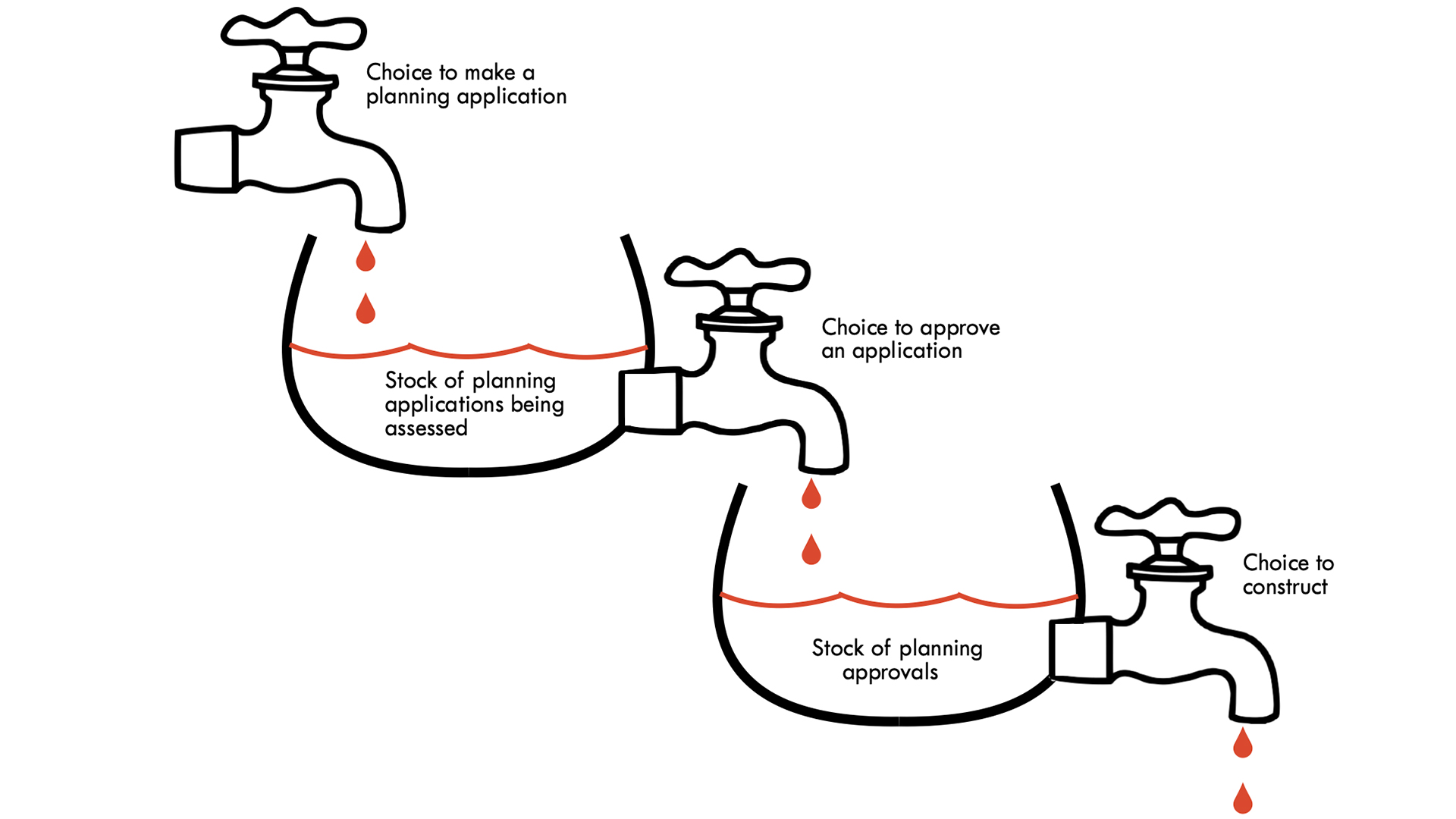
For example, Stockland holds a $3.8 billion residential landbank,6 and Lendlease holds a $3.6 billion landbank.7 Instead of accepting lower prices to sell more new housing, developers simply reduce their supply.8
Moreover, in a separate study of Auckland, New Zealand, Murray’s research showed no evidence that large-scale upzoning increased housing construction.9 Again, I am not advocating that the planning system can’t be improved or that the same dynamic exists in every country. But I am advocating that we decouple modular construction’s benefits from oversimplified supply and demand arguments.
To reframe, what does industrialised construction look like when we accept housing supply is constrained by developers, not planning legislation?
Reframe 3 – Scale only once achieving a product-market fit
Due to the capital-intensive nature of modular construction, external capital is often necessary. This requirement fosters a go big or go home mentality, fuelled by venture capital investors wanting to see a ten times return on their investment. This requirement becomes highly problematic as it inadvertently reduces the target market. It limits potential clients to those who require enormous volume, year-in and year-out, for the organisation to scale. This effectively limits the pool of potential clients to mostly government agencies, a problem that we’ll come to shortly.
Blitzscaling, as Reid Hoffman coined it, is high-risk, high-reward.10 One only has to look at other industries that have embraced Blitzscaling to see how they have struggled, even the so-called unicorns. Uber, Airbnb, and WeWork all consistently lose vast sums of money. It is foolish to believe that the construction industry, modular or otherwise, isn’t subject to the same dynamics. Scaling in the hope of one day becoming profitable is a recipe for disaster.
Technology is not immune
Even tech-centric organisations are not immune from the risks of poor business models. History shows that the biggest contributing factor to the graveyard of AEC technology comes not from a lack of funding, ambition or skill but rather from poor business models. Flux invested US$1 million in developing Flux Metro only to receive a dismal several hundred dollars in revenue. SoftBank invested US$10.65 billion into WeWork, but their in-house tech solutions couldn’t arrest Adam Neumann’s delusions of grandeur, which cost the company more than US$1.6 billion a year in losses. Similarly, Katerra’s building lifecycle platform, Apollo, couldn’t compensate for a product that no one wanted to buy – at least not at the scale they needed to be profitable. And more recently, LendLease has shelved their Podium platform after investing over $50 million into its development.
None of this should come as a surprise. As Tony Fadell describes, one only needs to look at the body count of virtual reality (VR) – dead startups as far as the eye can see and billions of dollars burned up over the past thirty years.11 And for what? It was reported that Decentraland, arguably the largest and most relevant Metaverse platform, had only 38 active daily users. And Meta’s flagship product, Horizon Worlds, produced no more than $470 in revenue globally.12 Just because you build it doesn’t mean they will come.
Rethinking the business model
Modular’s challenge is that their business model is premised on huge upfront capital to enable mass production. However, the sheer magnitude of sunk costs limits the organisation’s ability to iterate. It is hit or miss. This is highly risky, as we’ve seen, as without a sound business model, everything else is irrelevant.
To reframe, what does industrialised construction look like when business models don’t rely on endless external capital and instead are grown sustainably?
Reframe 4 – Government intervention is not a silver bullet
Modular construction has consistently lobbied for government intervention to guarantee their pipeline. The most widely cited case study is Sweden, whose government launched the Million Homes Project (Miljonprogrammet) in 1964 to build a million homes in ten years in response to a severe housing shortage. Modular construction now accounts for 84% of new detached housing in Sweden.13 This is compared to about 15% in Japan and 5% in the USA, UK and Australia.


Other countries are now seeking to replicate this success. In Australia, School Infrastructure NSW are delivering numerous schools via its Modern Methods of Construction program. In the UK, Homes England is pushing Modern Methods of Construction (MMC) via its Affordable Homes Programme (AHP), which requires 25% of all homes built through the scheme to use MMC. Some consider government intervention unfair market interference and that the market should decide on the best construction method. Mike Leonard from the Building Alliance, for example, asks “Does the government tell car manufacturers how to build cars? They don’t – they leave that to the market and the industry to produce the right solutions. And that’s fair, and that’s good governance.”16
Towards a free market
But government intervention is not the silver bullet many think it to be. In (most) democratic countries, governments come and go, and so too do policies and frameworks. Moreover, those sceptical in nature will claim that governments not hitting their affordable housing targets is deliberate as it reduces the number of subsidies they are required to pay. Relying on government intervention to subsidise a poor business model simply isn’t sustainable. Only through broader free market adoption, can a sustained pipeline be achieved.
To reframe, what does industrialised construction look like when we don’t rely on government intervention and instead rely on the free market?
Reframe 5 – Industrialised construction is not the same as manufacturing
If only it weren’t for the people…
Kurt vonnegut, Player Piano
Earth would be an engineer’s paradise.
Despite their best efforts to standardise design, industrialised construction is not the same as the automotive industry. Globally, the variation of cars boils down to two differences: the location of the steering wheel and the tail light colour.17 But even with these differences, the vehicle can be driven, albeit illegally, anywhere in the world.

Contrast this to construction. Every site will likely have a unique aspect, shape, topography and soil conditions. Lots on the same street will likely have different planning controls. Some locations will require seismic and flood mitigation. And building codes often aren’t even unified at a national level, let alone at an international level. And all of this is before considering variations in vernacular architecture, market preferences, or supply chain logistics. The same building cannot be built anywhere in the world. This is why construction is not manufacturing. It is for these reasons that industrialised housing is an exercise in diversity, not similarity.19
Economies of scale
Beyond design and aesthetics, there is also the question of scale. Take, for instance, the annual production output of one of the largest and most successful modular organisations, Sekisui House, which produces approximately 50,000 detached houses annually. In isolation, this is an impressive amount. But to contextualise, it also took them 62 years to achieve this level of scale. In fact, over its entire 62-year history, Sekisui House has built a cumulative total of only 2.62 million dwellings.
This is a far cry from Ford, who produced over 15 million Model T cars over 19 years – between 1908 and 1927. Today, Ford produces approximately 2-4 million vehicles per annum. That is not to say that to achieve economies of scale, industrialised constructions must match the automotive industry’s production output. But instead, to highlight that construction generally lacks the critical mass required for a volume-operation business model based on low cost.
To reframe, what does industrialised construction look like when we don’t try to force the world to be uniform but rather embrace its complexity and nuances?
Reframe 6 – Good design is about effectiveness, not merely efficiency
Post WWII, many countries had a critical housing shortage, and their attention turned to mass redevelopment. This rebuilding process coincided with the Modernist architectural movement when architectural thinking was dominated by functionalism and uniformity. In other words, rolling out dull, repetitive buildings at the time was considered entirely acceptable. This philosophy dovetailed nicely with modular construction’s unwavering belief in standardisation and mass production. For example, Brian Potter states, “Empirically, many (likely most) new housing developments in the US consist of a small number of floor plans copied over and over again.”20 This is probably true and not limited to just the US.


The problem with this line of thinking is that rather than asking what’s best for the end user and the urban environment, the narrative is distilled down to what is easiest to manufacture. The argument is that there is already lots of repetition; therefore, repetition is acceptable. But just because something exists doesn’t make it right. Ford’s Model T cars did not have seatbelts. Does that mean cars today don’t need seatbelts? Of course not. Our thinking has evolved in line with knowledge as it became available. The same must be done with architecture.
Left unchecked, modular’s default is to repeat the module as much as possible without variation. But while this might have passed during Modernism, we now know the devastating social consequence of these actions: crime, squalor and social dysfunction. Merely building more houses is not the end goal. The goal is to build better houses.
The psychology of heterogeneity
We shape our buildings and afterwards our buildings shape us.
Winston Churchill, 1943
Winston Churchill once mused that we shape our buildings, and afterwards, our buildings shape us. Since then, neuroscientists and psychologists have found plenty of evidence to back him up. Kate Jeffery, a behavioural neuroscientist at University College London, claims, “To feel connected to a place, you need to know how things relate to each other spatially. In other words, you need a sense of direction.”22 Similarly, the research of Colin Ellard, a professor of cognitive neuroscience at the University of Waterloo, found that “people are strongly affected by building façades. If the façade is complex and interesting, it affects people in a positive way; negatively if it is simple and monotonous.”23 Groove Armada was right – if everybody looked the same, we’d get tired of looking at each other.
While some may dismiss this as merely feel-good aesthetics, numerous studies show the detrimental health effects of poor design.24 Specifically, the main trigger appears to be what researchers call social stress, which is the lack of social bonding and cohesion in neighbourhoods. But you don’t need to be a neuroscientist or psychologist to know this. Anyone who has lived in or visited a Modernist housing estate, such as those in London, will attest that when efficiency is housing’s sole architectural driver, the results are profoundly depressing and can have significant social consequences that last generations.

What’s interesting about these findings is that it is not just about good versus bad design. It is about good design AND the lack of repetition. This finding challenges the conviction that simply because a design is considered good, doesn’t mean it should be copied ad nauseam.
To reframe, what does industrialised construction look like when good design is not merely about efficiency but about effectiveness?
What does modular 2.0 look like?
What does industrialised construction look like when it isn’t the saviour to the housing crisis; where we accept housing supply is constrained by developers, not planning legislation; where business models don’t rely on endless external capital and instead are grown sustainably; where we don’t rely on government intervention and instead rely on the free market; where we don’t try to force the world to be uniform, but rather embrace its complexity and nuances; and finally, where good design is not merely about efficiency but about effectiveness. What does that look like?
In ancient Greece, Plutarch wrote of a wooden ship that Theseus sailed from Crete to Athens. To preserve the ship, as its old planks decayed, Athenians would replace them with new wood. Eventually, all the planks had been replaced. It looked like the same ship, but none of its parts was the same. Was it still the same ship?26
The same logic can be asked of modular construction. Without mass standardisation and mass production, is it still modular construction? Possibly, possibly not. In this context, I prefer the term Modern Methods of Construction as it opens up many more possibilities, free from preconceived ideas that have plagued modular. Modular construction should never have been an object in and of itself. As Aitchison rightly concludes, “Prefabrication does not have intrinsic value, nor is it some kind of quality to be aspired to. Rather, prefabrication and industrialisation are a means to an end.”27
Conclusion
Modular construction has promised many things over the years. But like most things, our first ideas are often the most conventional – the closest to the default that already exists. They are also the ones most likely to fail, as has been the case repeatedly for modular organisations. Only once we realise that mass standardisation and mass production are only one means to an end will we finally move beyond its shitty first draft and see industrialised construction succeed at scale.
References
1 Grant, A. (2021). Think again: The power of knowing what you don’t know. WH Allen, London, p.61.
2 Aitchison, M. (Host) (8 Dec 2022). Future building podcast: Five myths of housing affordability with Dr Cameron Murray. Building 4.0 CRC.
3 Murray, C. (14 Feb 2020). The Australian housing supply myth. In Australian planner, vol.57(1), pp.1-12.
4 Murray, C. (9 Jul 2023). Explainer: Building and planning approvals. Fresh economic thinking.
5 Murray, C. (9 Jul 2023). Explainer: Building and planning approvals. Fresh economic thinking.
6 Stockland. (2023). Annual Report 2022-23, p.117.
7 Lendlease. (2023). Annual Report 2022-23, p.126.
8 Murray, C. (14 Feb 2020). The Australian housing supply myth. In Australian planner, vol.57(1), pp.1-12.
9 Murray, C. (4 Jun 2023). The Auckland myth: There is no evidence that upzoning increased housing construction. Fresh economic thinking.
10 Hoffman, R. & Yeh, C. (2018). Blitzscaling: The lightning-fast path to building massively valuable companies. Harper Collins, London.
11 Fadell, T. (2022). Build: An unorthodox guide to making things worth making. Penguin Random House, London, p.15.
12 Wagner, K. (3 Jul 2023). Lessons from the catastrophic failure of the metaverse. In The Nation.
13 Scandinavia prefabricated housing market & share analysis – Growth trends & forecasts (2023-2028). Mordor Intelligence.
14 Koopmans, R. Fisksätra. Ryan Koopmans.
15 Koopmans, R. Tensta.Ryan Koopmans.
16 Lowe, T. (2 Aug 2022). Why are we struggling to make modular work? In Building.
17 Aitchison, M. (2018). Prefab housing and the future of building: Product to process. Lund Humphries, London, p.79.
18 Hanft, A. (4 Oct 2015). The zombie-mobile. Medium.
19 Aitchison, M. (2018). Prefab housing and the future of building: Product to process. Lund Humphries, London, pp.79-80.
20 Potter, B. (2 Dec 2022). Are design variations a real issue? In Offsite builder magazine.
21 Koopmans, R. Huaxi Village. Ryan Koopmans.
22 Bond, M. (6 Jun 2017). The hidden ways that architecture affects how you feel. In BBC.
23 Bond, M. (6 Jun 2017). The hidden ways that architecture affects how you feel. In BBC.
24 Newbury, J. et al. (Nov 2016). Why are children in urban neighborhoods at increased risk for psychotic symptoms? Findings from a UK longitudinal cohort study. In Schizophrenia Bulletin, vol.42(6), pp.1372-1383.
25 Wolf. M. Architecture of density.
26 Grant, A. (2021). Think again: The power of knowing what you don’t know. WH Allen, London, p.132.
27 Aitchison, M. (2018). Prefab housing and the future of building: Product to process. Lund Humphries, London, p.64.









1 Comment
Ross Karp
Well written
Well researched
We are in the business and trying in some ways to deal with issues raised.
We are finding government wants houses but is sidestepping anyone wanting to talk to them about modular prefabricated construction in housing even though they are seriously embracing it in the education sector.
We are looking at a hybrid option which deals with site issues and module connectivity to services using in place construction .
The residential units (class 3) are prefabricated overseas but the facade elements hang onto the modules and have a large number of variations depending on orientation and views and aesthetics responding to the function and built and natural environment.
The big test is whether the industrialized model can be produced at less cost than the tried and tested and refined in-situation model.
It’s only real advantage if costa are the same is the factory controlled environment and quality assurance.
And that creates a whole raft of issues with approvals etc.