
Design technology in the AEC has undergone significant change over the past two decades. Each new arrival was accompanied by great fanfare and grandiose promises of being the next big thing. While some endured, others faded into the distance. Unlike earlier design-technology advances, Artificial Intelligence is upending both design technology and how organisations operate.
Introduction
Anyone who has followed design technology in the AEC industry will be acutely aware of the changing landscape. When I first started Parametric Monkey over a decade ago, the topic du jour was interoperability. Workflows for converting models from Rhino to Revit and the need for a BIM ecosystem were front and centre. Turbocharging this movement was Flux, a startup that spun out of Google[x] in 2010 with US$29 million in funding.
Around the same time, 3D printing was gaining prominence. MakerBots sat proudly in the lobbies of architectural offices, surrounded by fluoro-coloured plastic offspring. Meanwhile, Arup unveiled its first 3D-printed structural steel building components.1 And 3D-printed houses were starting to pop up around the world.
After acquiring the computational design studio The Living in 2014, Autodesk declared that the future was Generative Design, with Autodesk University’s 2017 exhibition hall and absurd bicycle designs becoming the personification of the new revolution.2
Next came virtual reality. In-house visualisation departments quickly switched from static rendering software to dynamic gaming environments. Startups like Arkio arrived on the scene.3 Autodesk bundled in Epic Games’s Twinmotion with Revit, effectively giving away a free license with every active seat of Revit.4 Facebook’s fascination with the metaverse led it to change its name to Meta.5 Meanwhile, Zaha Hadid Architects announced it had designed a virtual city in Liberland Metaverse.6 Supporting all of it was McKinsey & Company’s report claiming that the metaverse had the potential to generate up to US$5 trillion in value by 2030.7
Blockchain made a cameo appearance, promising data exchange through securely recorded transactions.
BIM 2.0 saw a new generation of cloud-native BIM tools emerge, including Snaptrude, Qonic, Arcol, Hypar, and Motif. While some aimed to dethrone Autodesk Revit as the primary authoring tool, most focused on the niche market of feasibility design as their metaphorical beachhead, to paraphrase Geoffrey Moore’s crossing-the-chasm theory.8
All that glitters isn’t gold
Each new design technology arrival was accompanied by great fanfare and grandiose promises of being the next big thing. While some endured, others faded into the distance. Flux shut down in 2018, only for the void to be filled by Speckle. 3D-printed houses have yet to go mainstream. Clients were thrust into virtual reality environments, only to flee just as quickly before nausea took hold. Meta has reportedly lost US$80 billion on the metaverse, with Zuckerberg’s vision of an immersive digital world on life support.9 Autodesk failed to mention in their marketing campaign that there was no magic generative design button and that if you wanted the future, you were going to have to code it yourself. As for blockchain, it remains as elusive as Satoshi Nakamoto. Finally, BIM 2.0’s focus on manual modelling, albeit in the cloud, may be dead in the water before it even begins.
Artificial Intelligence
More recently, it is clear that the future is Artificial Intelligence (AI). Unlike the design technology advances that came before, AI is upending both design technology and how organisations operate. At the centre of this revolution is Generative AI, a type of artificial intelligence designed to create original content, including text, images, audio, video, and even software code, based on patterns it has learned from massive datasets, mainly sourced from the internet.
Text-to-image generation
Starting in 2022, architects began experimenting with text-to-image generation using tools such as DALL-E, Midjourney and Stable Diffusion. At first, most architects treated generative AI as experiments separate from their professional work, largely out of fear of how the rest of the industry would react. By 2023, perceptions had shifted, with Patrik Schumacher announcing that Zaha Hadid Architects was using generative AI on most projects.10 Whether this was the defining moment that legitimised generative AI is debatable, but what is clear is that adoption has gone mainstream. Chaos Veras, which brought text-to-image generation directly into Revit, was when the industry could really start to see how generative AI could apply to professional work.11
Large language models
The next wave of AI saw architects experiment with Large Language Models (LLMs), most notably OpenAI’s ChatGPT, which burst onto the scene in November 2022. Other major players soon joined the party, with Microsoft Copilot (Feb 2023), Google Gemini (March 2023), and Anthropic Claude (March 2023) released shortly after. With Microsoft Copilot deeply integrated into Microsoft Windows, many AEC organisations simply adopted it by default.
Many of these organisations opted to host their own LLMs to create a so-called ‘in-house ChatGPT’. There were several reasons for this. Firstly, to prevent confidential information from being released into the ether. Second, ChatGPT and other pre-trained models have extensive knowledge, but they’re trained only once. They aren’t retrained daily, and therefore have a knowledge cutoff date. For example, GPT-5.6’s knowledge cutoff date is February 16, 2026, meaning the model doesn’t know about any information or events that occur after that date. Finally, LLMs may not know personal information or industry-specific information related to your business. Augmenting LLMs with your own proprietary business data can help fill these knowledge gaps.
Multimodal large language models
Not long after LLMs were released, Multimodal Large Language Models (MLLMs) emerged, breaking the text-only barrier by processing and understanding information across various modalities such as images, audio, and video, in addition to text. For example, Google’s Gemini Notebook (formerly NotebookLM) lets you upload PDFs, websites, YouTube videos, audio files, Google Docs, and Google Slides, and it provides instant insights with clear citations from those sources. The main benefit of MLLMs is that they provide a more complete understanding by synergising information from different data sources.
Agentic AI
More recently, Agentic AI systems have emerged, which, unlike traditional generative AI, not only think but also act. Agentic AI can set goals, plan, and execute tasks with minimal human intervention. Their autonomy is their primary benefit. However, this autonomy can have serious consequences if agentic systems go off the rails.
AI in design technology
It is clear that AI adoption has gone mainstream among AEC organisations. However, to date, adoption has mostly centred on universal business tasks, such as summarising emails, identifying trends, and prompting models for answers, rather than industry-specific tasks. But what about AI’s role in AEC’s design technology?
Text-to-BIM
In 2023, Hypar showcased how natural language prompts could generate a BIM model, known as text-to-BIM.12 However, this foray seems short-lived, as their business model pivoted to semi-automated space planning tools. Studio Tim Fu, who has become the poster child of the AI in architecture movement, explored similar avenues. In 2025, they showcased a prototype called UrbanGPT, which uses natural-language prompts to generate 3D urban layouts. More recently, Motif has shown it can generate models from text, sketches, or photos, creating a seamless BIM workflow in a browser.
The autonomous engineer
That same year, AECOM acquired Norwegian AI start-up, Consigli AS, for a staggering US$390m.13 Self-branded as ‘the autonomous engineer’, the platform claims to generate fully engineered interdisciplinary BIM models. AECOM saw the software as an existential threat and decided to act. What is interesting about this acquisition is that AEC organisations are now going head-to-head with global software vendors such as Autodesk, marking a shift from simply consuming AI to actively participating in its development. Time will tell if this bet pays off in the long run, but what can’t be ignored is that since the acquisition, AECOM’s stock has crashed a staggering 55% from US$132 to US$59 (as at 13 October 2026).
Autodesk Assistant
Earlier this year, Autodesk launched Autodesk Assistant, its natural-language tool integrated into Revit 2027. Since Autodesk Assistant launched a full three years after ChatGPT, it is no surprise it was met with a whimper, even among Autodesk die-hards. One only has to look at Apple to see that being late to the party doesn’t preclude you from leading the pack. But you must be better than your rivals, something Autodesk Assistant cannot claim. Ask it to do something, and you’ll likely be met with “I’m unable to carry out your request right now, but I can walk you through how to do it yourself.” Revit users wanting to use AI are best advised to explore third-party options, such as BIMLOGIQ Copilot or NonicaTab. However, for well-defined tasks you need to repeat frequently, pre-built Dynamo solutions are more robust and accurate.
AI-powered Grasshopper
In the McNeel world, Rhino and Grasshopper have seen an explosion of new AI-based plug-ins, including Ant, Raven, SmartHopper, Runchat, OKIE-5, and Planaria AI. Rather than writing Grasshopper scripts manually, these plug-ins let you describe what you want and have them build the script as you prompt. On the one hand, this workflow lowers the barrier to entry and opens up a whole world of possibilities. Whole graphs are literally created in seconds. On the other hand, the scripts it creates are often inefficient and struggle with complex or nested logic. Breaking the process down into smaller steps helps, but it isn’t always as simple as it sounds. Allow me to explain.
In cooking, it is easy to articulate what you want to cook. Lasagna, soufflé, beef wellington. But if you were asked to describe the step-by-step process, and you weren’t a chef, many would struggle without a recipe. And that’s the point. Knowledge elucidation is needed to capture and codify domain knowledge. In other words, it’s very hard to break down a complex workflow into discrete steps without already having the domain knowledge to do so. That said, I have no doubt these tools will keep improving, especially as more data becomes available for the models to train on.
Boom or bust?
Without a doubt, AI is here to stay and will continue to disrupt how we work. But to what extent? Gartner forecasts global spending on AI will total US$2.59 trillion in 2026, marking a 47% increase.14 But as the metaverse shows, pumping large sums of money into new technology doesn’t guarantee success. It needs to be profitable, and that is AI’s biggest hurdle. What we know is that AI tools and chatbots still do not make much money despite being costly to create, and Wall Street wants results, not more ideas.15
Consider the following. In March 2026, OpenAI raised US$122 billion, valuing the company at US$852 billion.16 With their latest funding round, they are now looking at a valuation of up to US$1.4 trillion.17 All of this is without turning a profit. For context, OpenAI is valued just behind Meta at US$1.8 trillion, but Meta made a US$60.46 billion profit last year. We know, of course, that Silicon Valley’s fascinated by Blitzscaling.18 But at some point, it simply isn’t sustainable.
Many, including Billionaire investor Ray Dalio, who predicted the 2008 financial crisis, are warning that we’re in an AI bubble and that when it bursts, it will be an order of magnitude worse than the dot-com bust of 2000. It is important to remember that the dot-com bust didn’t mean that the underlying technology of the internet was bad. It simply meant companies didn’t yet understand how to make a profit from it. Indeed, it took another 15 years for this to occur, and since then we haven’t looked back.
AEC in the age of automated creation
Time will tell whether AI continues to accelerate or its bubble will burst. Either way, AI is here to stay, and AEC organisations will need to adapt. With the release of generative AI, we’re already seeing foundational concepts being challenged.
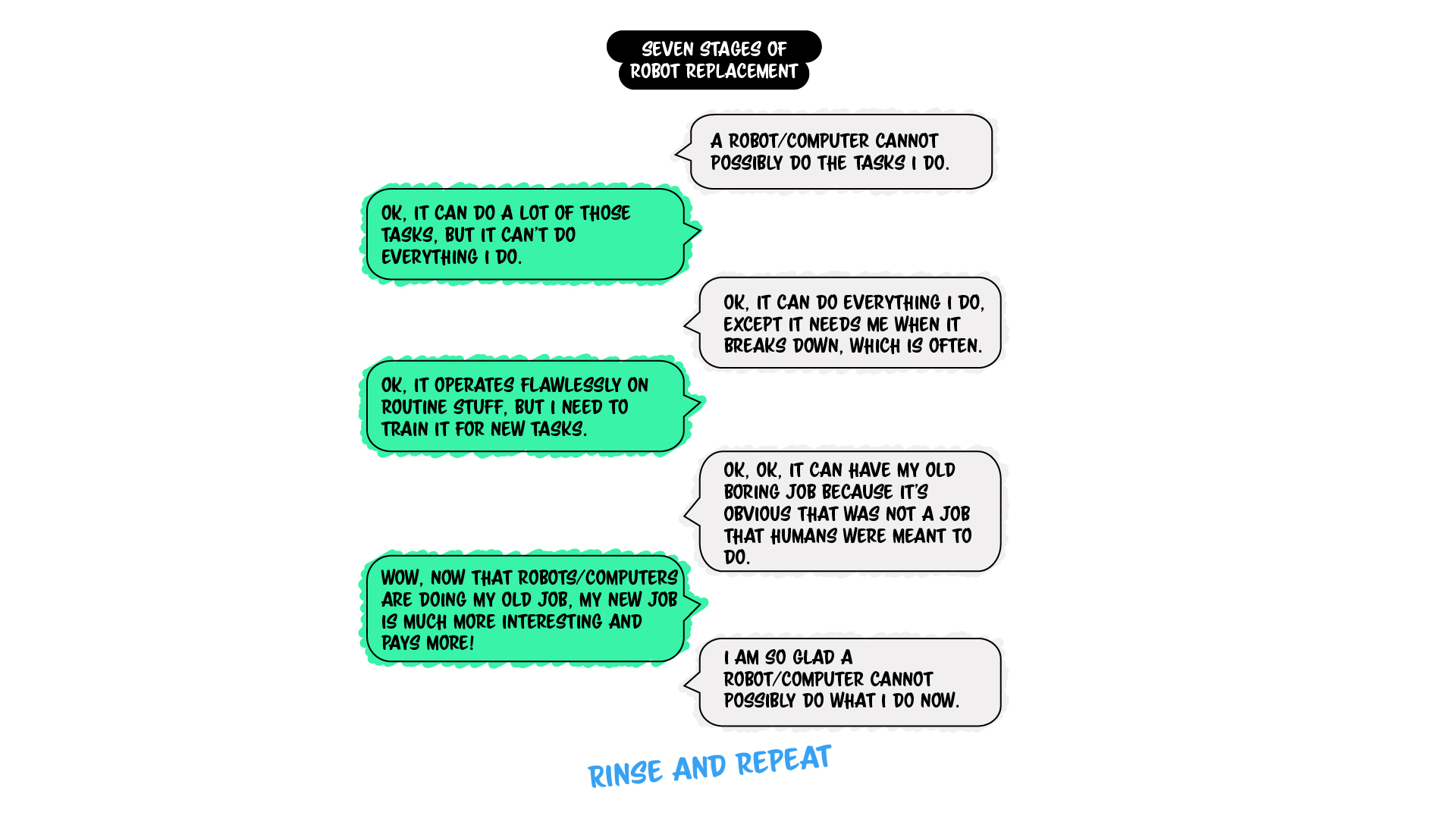
For decades, practising architects have lamented architectural student projects as fantastical and detached from commercial realities. However, in the blink of an eye, those attitudes seem to have been forgotten, as evidenced by the proliferation of AI slop. Framed as reimagining architecture, there is no discussion of data-driven design, embodied carbon, or sense of place; just the reduction of architecture to a procession of interchangeable images.
As OMA’s Reiner De Graaf points out, in a world of generative AI “style conventions, architectural syntax, laws of construction, building economy and other analogue absolutes fade into perfect insignificance in a universe of perpetual digital entropy.”20 Adjectives take the place of arguments and results bear no relation to effort. If the results are not to one’s liking, synonyms will generate new results in an instant. At the same time, prompt crafting requires no architectural education or background. All it requires are words, and anyone with basic literacy can participate.21
The case against AI
Most recently, OpenAI and Anthropic have both called for slowing the pace of AI model development to prevent models from getting out of control and becoming a threat to humanity.22 The optimist may view this as responsible development, while the pessimist may view this as hype designed to generate headlines. Either way, we know that most technology starts with a laudable goal, often to improve some aspect of our lives. Yet this doesn’t always eventuate.
Consider social media. Facebook aimed to connect people. Twitter was merely a platform for sharing short messages. And Snapchat enabled private, person-to-person photo sharing. But as we now know, there can be unintended consequences. Cambridge Analytica illicitly harvested personal data from Facebook accounts to influence voters’ behaviour in democratic elections. Twitter is awash with hate speech, misinformation and trolls. And Snapchat’s filters and visual effects have spawned a new body dysmorphia disorder, known as Snapchat dysmorphia, whereby people seek out cosmetic procedures to replicate the altered images they present online.
So now that we have AI, what unintended consequences will follow? Ironically, research suggests that while employees may be becoming more efficient, this is creating cognitive atrophy, resulting in reduced critical thinking and creativity.23 If this is the case, we have AI freeing us up to make decisions, but at the same time, reducing our critical thinking to make good decisions. Conundrum.
Embracing change
One of our very first articles was A brief history of computation, where we described the five eras of computation. The fifth and final era was coined the machine learning era, which combines a range of algorithms, pattern recognition, neural networks, generative design, artificial intelligence, and distributed computation to change how we make things. Whereas previous computation eras used new technology to implement the old science we knew, we’re now learning that computers work better and faster when we let them follow a different, nonhuman, postscientific method.24 Eight years on since that article was written, we’re starting to see the ramifications of this digital revolution-for the organisations and the industry as a whole.

We’re seeing how the tech stack has changed. New software that didn’t even exist a few years ago is now ubiquitous. We’re seeing style conventions and architectural syntax fade into insignificance. We’re seeing laypeople with basic literacy skills generate designs. And we’re even seeing the fundamental concept of BIM being challenged. BIM has always aimed to minimise abortive work by standardising documentation and naming conventions, and by developing templates and a ‘family’ library to ensure organisational consistency. But in a world where change comes with a few text prompts, the traditional BIM workflow is under threat.
From a management perspective, the digital revolution is undermining traditional organisational hierarchies. Reiner De Graaf once again hits the nail on the head when he says:
Most founders, figureheads and even senior staff of architecture offices are of a generation that, at best, can hope to be tolerated spectators in a space where essentially all the productive work is done by others. More than anything, the digital revolution has finalised the divorce between the production of an office and those leading it. With the likely exception of Patrik Schumacher, the current principal of Zaha Hadid Architects, no architect running an office today can understand the basics of these technologies.25
Quite simply, change is here, and we need to embrace it.
Conclusion
For years, the AEC industry has opted for incremental change over disruptive change. With the advent of AI, organisations no longer have a choice. AI is disrupting how we work. There will still be late adopters and laggards, but without a compelling competitive moat, I fear that these organisations will struggle to survive. This doesn’t mean that organisations have to go all in on AI. There is compelling evidence to show that cognitive offloading has unintended consequences. A balance is still required. What that balance looks like, I’m sure we’ll soon discover. But through it all, we’re going to have to unlearn much of what we think we know. The genie is out of the bottle, and there is no going back.
References
1 Winston, A. (11 Jun 2014). Arup unveils its first 3D-printed structural steel building components. In Dezeen.
2 Lau, W. (27 Jun 2014). Autodesk Acquires David Benjamin’s Design Studio, The Living. In Architect Magazine.
3 Day, M. (1 Jun 2021). Arkio: collaborative design for architects in VR. In AEC Magazine.
4 Day, M. (27 Sept 2022). Autodesk to bundle Epic Games Twinmotion with Revit. In AEC Magazine.
5 Thomas, D. (29 Oct 2021). Facebook changes its name to Meta in major rebrand. In BBC.
6 Finney, A. (11 Mar 2022). Zaha Hadid Architects designs virtual Liberland Metaverse city. In Dezeen.
7 McKinsey & Company. (Jun 2022). Value creation in the Metaverse.
8 Moore, G. (2014). Crossing the chasm. Harper Collins, New York.
9 Tan, E. & Issac, M. (19 Mar 2026). The Long Farewell to Mark Zuckerberg’s Metaverse. In The New York Times.
10 Barker, N. (26 April 2023). ZHA developing “most” projects using AI-generated images says Patrik Schumacher. In Deezen.
11 Day, M. (30 Jan 2023). Veras: AI-based renderer for Revit models. In AEC Magazine.
12 Day, M. (21 Mar 2023). Hypar: text-to-BIM and beyond. In AEC Magazine.
13 AEC Magazine. (25 Noc 2025). Aecom acquires AI start-up Consigli.
14 Gartner. (19 May 2026). Gartner Forecasts Worldwide AI Spending to Grow 47% in 2026.
15 Hays, K. (31 July 2026). Amazon and Apple just told us more about their AI plans – here are three things we learned. In BBC.
16 OpenAI. (31 Mar 2026). OpenAI raises $122 billion to accelerate the next phase of AI.
17 Sweney, M. (9 Oct 2026). OpenAI projected to bring in $20bn less in revenue than expected. In BBC.
18 Hoffman, R. & Yeh, C. (2018). Blitzscaling: The lightning-fast path to building massively valuable companies. Harper Collins, London.
19 Kelly, K. (2017). The inevitable: Understanding the 12 technological forces that will shape our future. Penguin Books, New York, p.59.
20 De Graaf, R. (2026). Architecture against architecture: A manifesto. Verso, London, p.97.
21 De Graaf, R. (2026). Architecture against architecture: A manifesto. Verso, London, p. 101.
22 Kola, P. & Jamali, L. (12 Sept 2026). Anthropic boss Dario Amodei calls for AI development to slow down. In BBC.
23 Germain, T. (6 May 2026). ‘Think outside the bots’: How to stop AI from turning your brain to mush. In BBC.
24 Carpo, M. (2017). The Second Digital Turn: Design Beyond Intelligence. The MIT Press, Cambridge, p. 7.
25 De Graaf, R. (2026). Architecture against architecture: A manifesto. Verso, London, p.17.